
 Peter
Peter Martin
 Sarah
Sarah Naomi
Naomi Fillip
 Kenzo
Kenzo Lisbeth
 Elyna
ElynaSo here is the whole game in one breath: You are a CEO. You have three fiscal years to finish with the most cash. Build products. Hire people. Invest wisely. When honest growth feels inconvenient, sue your neighbours, smear them in the press and steal their best employees. Then look genuinely surprised when they do it back.
You could start playing right now. But if you'd like to actually win, read on.
A game is 3 fiscal years. Every year has the exact same two beats.
 The Draft
Everyone gets a hand of cards. At the same time, each of you keeps one card and passes the rest to a neighbour. Repeat until the hands are used up. This is where you build your company, and where you knife everyone else's.
 The Reckoning
The books close. Each CEO adds up income, pays expenses and tax, repays loans, and finds out whether they survived the year. Do this three times. Then count the cash.
Each round, everyone does this at the same time: choose one card, reveal, resolve, pass the rest. The year's hand is 8 cards, and every expansion card pack adds one more.

Pay its cost in cash and place it in front of you. Playing is how you hire, launch a product, take a loan, or attack a neighbour.
Can't afford anything? Slide one card away and take +1M cash instead. A discarded card does nothing but line your pockets.
The remaining cards move to your neighbour (automatically in the digital edition): years 1 & 3 to the LEFT, year 2 to the RIGHT. Your next hand arrives from the other side.
Every card belongs to one of five types: Investment (cash and income engines), Connection (bank loans, tax tricks and shady favours), Work Environment (well-being and shields), Employee (your workforce) and Competition (the dirty tricks). The field guide further down covers each of them.
When the round's played cards interact, they resolve in a fixed order:
Investment → Connection → Work Environment → Employee → Competition.
Everything resolves within the same round: shitstorm damage lands immediately, it does not wait for the year-end settlement (only lawsuits do, decided at the verdict). But within the round the attacks resolve last, so a shield your rival plays in the same round takes effect before the storm hits.
Your company is measured on three tracks, each from 0 to 7. Cards and employees push them up. They are the engine of everything, and they are permanent: climb early and they pay you every year that follows.

How good your product is. Protects you against consumer surveys and powers your product cards and income.

How happy your people are. Shields you from shitstorms and illness, and at step 5+ your wage rises are halved.

Your firepower in court. Each step pays +1M income every year, and Legal decides every lawsuit.
Every card is a small illustrated contract. Here is how to read one at a glance.
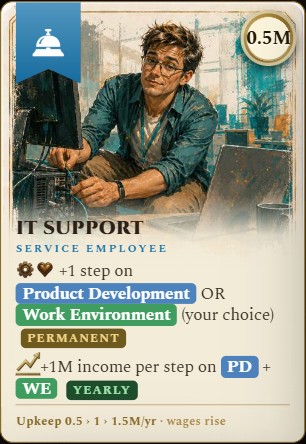
Your opponents' small boards shorten the three scales, using the game's original Danish short forms. Here's the key:
Each scale runs from 0 to 7. Hover a row in the game for the full name.
A handful of real cards from the game. Hover any of them to see what it does.
 i
i
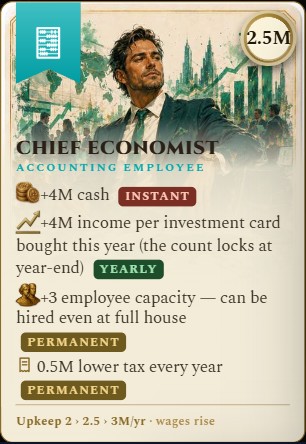
An income engine in a suit: 4M cash now, then 4M every year for each investment card you buy this year. Adds room for three extra hires and shaves your tax. Finance people pay for themselves.
 i
i
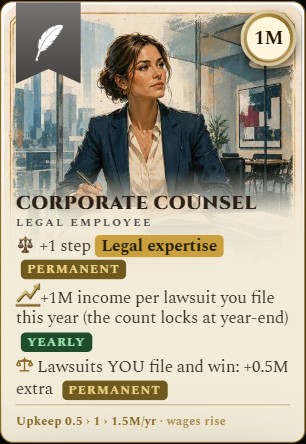
A legal hire that bills you income for every lawsuit you file, plus a bonus for each one you win. The heart of a courtroom strategy.
 i
i
Take your left neighbour to court. The plaintiff wins ties on Legal, and the verdict lands at the year-end Reckoning.
 i
i
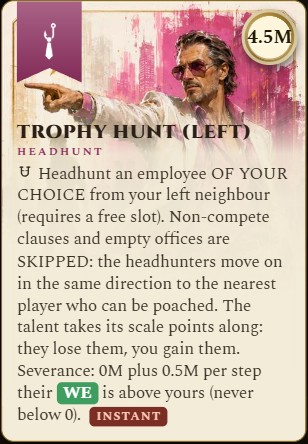
From the Headhunters expansion: steal your left neighbour's best-fit employee, and the scale points that hire earned go with them. Non-compete clauses protect their owner, but the hunt moves on to the nearest unprotected office.
Cash is what you have (and your score). Income is what arrives at the Reckoning. A card usually costs cash now but pays income every year, so an early hire is worth far more than a late one. Confusing the two is how profitable companies go bankrupt, both here and elsewhere.
Every card in play has a running cost. Minimum expenses are always at least 1M + 0.5M per employee, and each employee costs +0.5M more per year for every year employed (Work Environment 5+ halves those raises, rounded up to the nearest half). But the trap that actually catches beginners is capacity: you only have room for so many employees, and suddenly you cannot hire anyone. Finance staff (Accounting) can always be hired and expand your capacity themselves, so buy them before you fill up.
Pay tax on the year's profit (income minus expenses): 1M, plus 1M per full 5M of profit. A loss year is tax-free. Every accounting employee and leaf-marked card lowers the tax by 0.5M, and an offshore account cuts 1.5M to 4M a year depending on the haven, all the way down to zero. All tax collected lands in the taxman's pool at the table. Growing fast without a finance function is dangerous.
Some cards let you take a bank loan: plenty of cash now, and an instalment at every Reckoning for the rest of the game. The total always exceeds the loan, because the bank always wins. An offshore account makes the instalments cheaper. Great for a big early move, just remember the debt follows you to the final settlement.
Attacks only ever hit the neighbour on your left or your right. Choose your seat wisely, because that is who you'll spend three years quietly ruining.
LEFT RIVALYOURIGHT RIVALDecided at the Reckoning, purely on Legal: the plaintiff wins on an equal or higher Legal step. Filing is an advantage: ties go to the attacker. Lawyer up, or don't get sued.
A media firestorm. It bites harder the more your Communication team outguns their Work Environment, and it always lands at least a glancing blow. Miserable staff have no goodwill to spend.
A hit piece dressed up as research. It scales against their Product Development: a genuinely great product is hard to smear.
From the Headhunters expansion: steal the employee that fits you best. The talent leaves them and joins you, and takes their scale points along (their tracks drop, yours rise).
The arrows across the table (and the game's log) tell you exactly who is aiming at you. And a lawsuit is a slow blade: it's filed now but only decided at the year-end Reckoning, which leaves you the whole year to defend yourself.
A shitstorm or a consumer survey (forbrugeranalyse) is the opposite: a fast blade. It lands the instant it's played and you feel it at once: your yearly income takes the hit then and there (the log names who did it). Surveys are measured in scale leads, so a high scale shrugs most of it off; shitstorms are a pure marketing duel, where your own comms staff and a green image are the defence. And a spin doctor (from the Lobbyists expansion) can even reflect them back at the sender.

A crown marks whoever is currently set to win: the most useful thing on the table. When someone pulls ahead, the smart move is for everyone else to point their knives at them, before they run away with it.
When the hands run out, every company closes its books in this order.
 After the third Reckoning, everyone still standing counts their cash. The richest CEO wins the reckoning. Good luck. You'll need less of it than you think, and more nerve.
Read this once and it all clicks. Meet three CEOs: you (Peter), Sarah on your left, and Martin on your right.
SARAH · leftYOU · PeterMARTIN · rightYour hand has a great Accountant, a cheap Product Developer, and a Lawsuit. You want the Accountant, but if you pass it left, Sarah hires it, and she's already rich. So you play the cheap Product Developer (it pays income all game) and pass the rest left. That lovely Accountant is now heading into Sarah's hands. Annoying.
You take a Bank Loan to afford a Lawyer (Legal 0 → 2), draft a couple of income cards, and fire a Consumer Survey at Martin's flimsy product. Martin, bless him, keeps discarding cards for quick cash and wonders why his product is being torn apart in the press.
Court: you sued Martin: your Legal 2 beats his 0, and he pays up. Books: income covers expenses, and your one Accountant even trims your tax. Loan: comes due; you planned for it and end the year comfortably in the black. Martin survives, barely, and now has you squarely in his sights for next year. Two more years like that and someone gets very rich. Make it you.
You don't need this to play. It's here for when a question comes up. The types are also the order cards resolve in each round.

Cash-and-income engines: webshops, stock, solar farms, IPOs, grants. The safe, boring, extremely effective backbone of a fortune.
Favours and financial engineering: bank loans, offshore accounts (permanent tax relief + cheaper loans), subsidies and lobbying (the Lobbyists expansion), and the covert jobs, like planting evidence on a neighbour. They bend the rules in your favour.
Cards that raise your Work Environment and shield you from shitstorms and illness. Home of the satirical parental-leave cards from the Headhunters expansion.
Your workforce in five colours (Service, Communication, Sales, Legal, Accounting). They push scales and income, but eat capacity and rack up wages. Salespeople fight their own duel, the Client Raid: at every year-end settlement you steal 0.5M income per surplus salesperson, vs each rival, and vice versa (the Head of Sales counts as two). Can only be fired through cards (Restructuring), or poached if you play with the Headhunters.
The dirty tricks: lawsuits, shitstorms, surveys, illness, and with the Headhunters expansion, poaching. Always target a left or right neighbour, and land after everyone has finished building for the round.
Each card expansion adds 1 card to every hand, so the years run richer.

Draft four board demands, commit to one each year. Meet it for a bonus, miss it and pay a fine. The art is promising the right thing at the right time.

Staff warfare. Poach the employee that fits you best (they take their scale points along) and defend your own with non-compete clauses. Includes the parental-leave cards.

Lobbying, greenwashing and spin doctors. Build Political Influence (0 to 7) for state subsidies, bid on the yearly public tender (your bid plus your influence wins, if you meet its requirement), draw money straight from the tax pool, greenwash your tax down, and turn media attacks back on their senders.

Six more CEOs to sit at the table: the ex-banker, the serial founder, the HR director, the former judge, the influencer and the landowner, each with their own perk.
Click an expansion to see it up close, cards and all.
With 4 players you can play two teams of two. With 6, also three teams of two (2v2v2). Digitally, pick Teams in the Opponents section on the start screen; at the physical table, simply agree before dealing.
Teams are seated alternately around the table, so your neighbours are always opponents. Attacks only ever hit neighbours, which means they can never hit your partner.
Victory goes to the team's combined cash after the final year-end settlement. The richest player at the table can easily sit on the losing team.
Plan together all you like, but each player still runs their own company with their own hand. Split the roles: one builds the money machine, one wages war on the neighbours.
Legal is quietly the strongest track: every step pays income and lets you win lawsuits against your neighbours. Build it early and the courtroom becomes a money machine. Do not treat suing as a last resort.
Cash is only the final scoreboard. What wins is turning it into things that pay you every year: staff, products, retainers. A little paid annually usually beats a one-off lump.
The bigger the profit, the higher up the tax ladder you climb, and a team gets pricier the longer it stays. Accountants and an offshore account cut the tax; a high Work Environment curbs the wage creep. Grow the parts that pay you.
 Ruthless Returns · Regnskabets Time · A game by Thomas Lay & Diana C. L. · © 2026 South Harbour Studios · Privacy